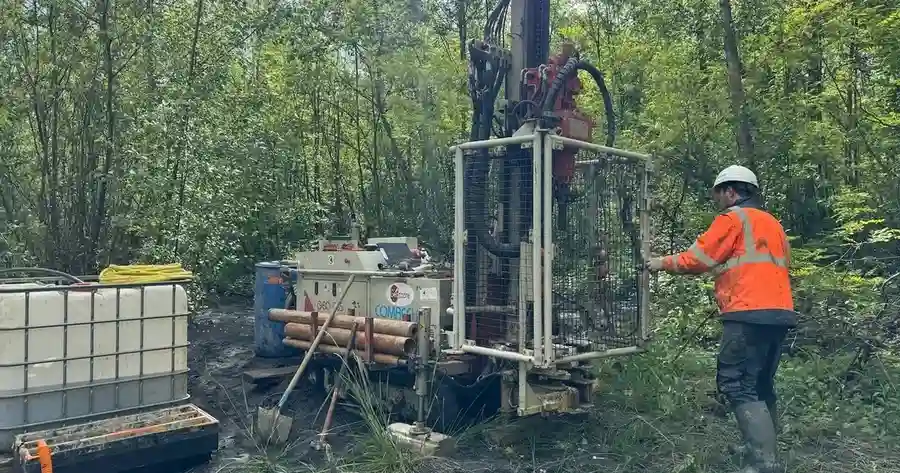
A four-story office building near Five Points South started showing slab cracks within two years of completion. The forensic investigation traced it back to differential settlement in partially weathered shale, a material that looked like rock in the borehole photos but degraded rapidly when exposed to moisture cycles. That scenario repeats across Birmingham more often than anyone wants to admit. The city sits on a complex transition zone between the Valley and Ridge physiographic province and the Piedmont, which means soil profiles can change completely within a single block. We run the full suite of ASTM D2487 classification tests, consolidation analysis, and shear strength determination to give structural engineers a real picture of what lies beneath the site. Before committing to a foundation design, many projects in the area combine soil mechanics data with spt-drilling to correlate blow counts with laboratory strength parameters, especially where the residual soils show high variability in the upper 20 feet. We also cross-reference results with atterberg-limits when the fines content suggests expansive potential, a common concern in the Conasauga Formation materials that underlie much of Jefferson County.
Birmingham's residual soils do not behave like textbook sedimentary deposits. Effective friction angles measured in the lab often differ by 4 to 6 degrees from published correlations, and that gap drives foundation costs.
Local ground factors
Chapter 18 of the IBC, as adopted by the City of Birmingham, requires a geotechnical investigation for all structures classified as Risk Category II or higher. The local amendment references the 2018 Alabama Building Code, which mandates laboratory testing when presumptive bearing values from Table 1806.2 are not conservative enough for the site conditions. In practice, that covers nearly every commercial project in the metro area. The Conasauga and Rome Formation materials that dominate the valley floors contain interbedded limestone and shale layers that weather at different rates, creating pockets of highly compressible clay adjacent to competent rock. A footing designed for uniform bearing can experience differential settlement exceeding 0.75 inches over a 20-foot span if the lab data is not incorporated into the foundation analysis. We have seen this exact failure mode in warehouse slabs near the I-65 corridor. When the consolidation curve shows a compression index above 0.35, the structural engineer needs to evaluate whether a rigid foundation system with mat-foundations provides better performance than isolated footings, particularly where column loads exceed 200 kips and the weathered zone extends deeper than 10 feet.
Common questions
What soil mechanics tests are required for a typical commercial building pad in Birmingham?
The minimum program under IBC Chapter 18 typically includes moisture content, Atterberg limits, grain size distribution with hydrometer, unconfined compression on cohesive samples, and one-dimensional consolidation if the weathered zone is thicker than 5 feet. For structures exceeding three stories or with column loads above 150 kips, we add consolidated-undrained triaxial tests to obtain effective stress strength parameters. The City of Birmingham plan review office may request direct shear data if the site is on a slope greater than 15 percent.
Why do Birmingham soils require site-specific strength testing instead of published correlations?
The residual soils derived from shale and limestone weathering in the Valley and Ridge province retain relict structures from the parent rock that produce anisotropic strength behavior. Published correlations developed for transported soils in other regions often overestimate the drained friction angle by 3 to 5 degrees in these materials. Running triaxial or direct shear tests on undisturbed samples gives parameters that reflect the actual fabric and stress history of the local formation, which directly impacts foundation sizing.
How much does a soil mechanics laboratory program cost for a project in the Birmingham area?
How long does the laboratory testing phase take for a Birmingham project?
Classification and index property tests are typically completed within 5 to 7 business days after sample delivery. Consolidation tests require 10 to 14 days due to the incremental loading schedule and the time needed for pore pressure dissipation in Birmingham's low-permeability residual silts. Triaxial programs add another 7 to 10 days. We coordinate the schedule with the drilling contractor so that the final report aligns with the foundation design milestone dates.