The rig arrives with a track-mounted SPT hammer and thin-wall Shelby tube samplers. In Birmingham, tunnel alignment investigations start with the residual silts and decomposed shale that define the upper 60 feet of the Valley and Ridge province. Crews mobilize to Red Mountain, North Birmingham, or along the CSX corridor where infrastructure demands underground passages. A typical campaign drills three to five borings per portal, advancing mud-rotary through fill and weathered rock until the refusal horizon. The goal is continuous core recovery through the proposed tunnel crown.
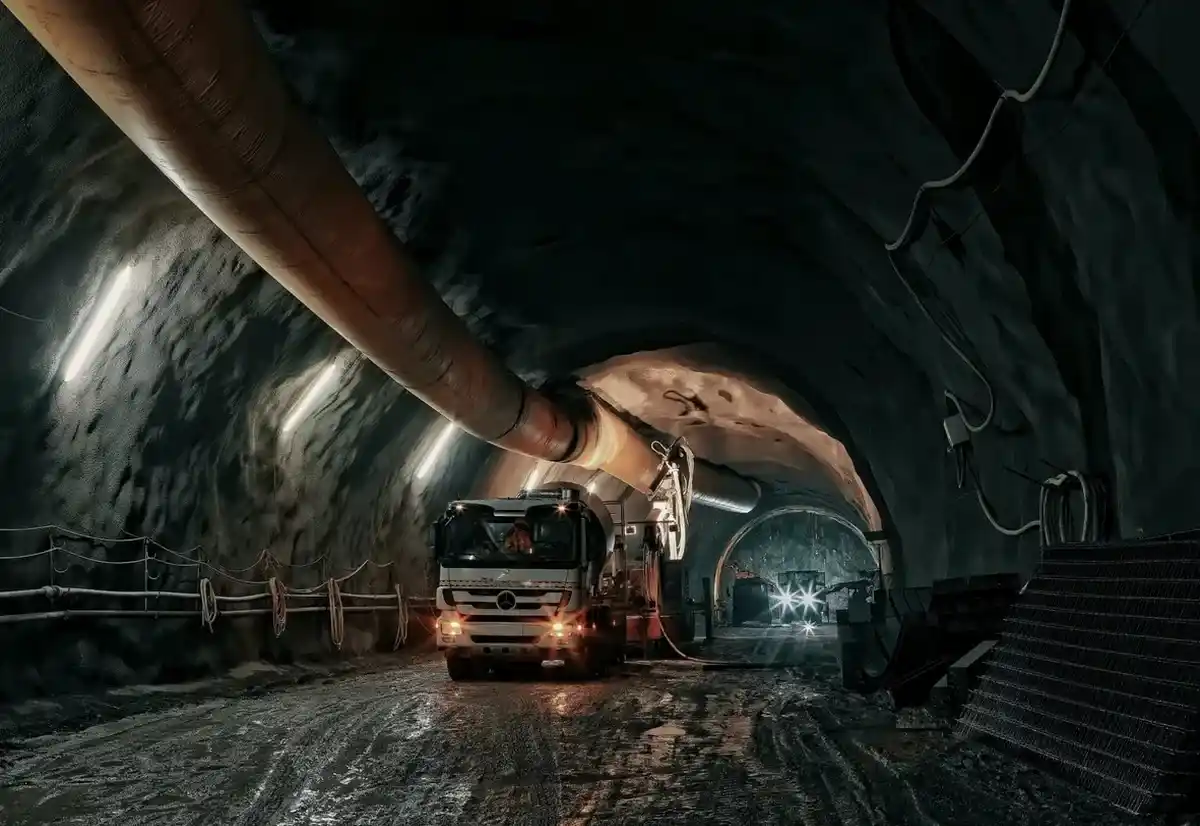
Before the TBM ever cuts, we correlate standard penetration data with soft-ground-tunnels assessments so the design team sees exactly where the soil-to-rock transition occurs and what the stand-up time will be without support.
In Birmingham's Piedmont saprolite, a soft-ground tunnel can encounter running sand, stiff clay, and partially weathered schist all in the same advance.
Local ground factors
A 1,200-foot stormwater diversion tunnel under the Railroad Park area ran into a lens of micaceous sand at the crown that had never appeared in the geotechnical baseline report. Within four hours, the face raveled, daylighted in a parking lot, and shut down the project for six weeks. That sand was only 18 inches thick but it was cohesionless, saturated, and completely hidden between two stiff clay units.
Birmingham's geology does not forgive assumptions. Soft-ground tunnels here demand a defensible baseline that maps every seam, lens, and weathered zone because the cost of a face collapse is measured in schedule delays, third-party damage, and OSHA recordable incidents. Settlement troughs in the overconsolidated clays of the Birmingham anticlinorium can extend 200 feet beyond the tunnel centerline, well into occupied structures.
Common questions
What makes Birmingham soil so challenging for tunnel boring?
The primary challenge is the Piedmont saprolite. Weathering of the underlying metamorphic rock produces a soil profile where fully decomposed material can sit directly next to moderately weathered rock with no gradual transition. A tunnel boring machine can go from soft clay to hard schist in less than ten feet. This mixed-face condition causes uneven cutter wear, face instability, and water inflow that complicates muck removal.
How many borings are typically required for a soft-ground tunnel alignment?
Industry practice and IBC Chapter 18 guidance calls for borings spaced no more than 200 feet apart along the alignment, with deeper borings at each portal and at any location where the tunnel crown approaches the soil-rock interface. For a typical Birmingham project, that translates to three to five borings per portal and additional probes at shaft locations and low-cover zones.
What laboratory tests are essential for the geotechnical report?
The non-negotiable tests are unconsolidated-undrained triaxial compression for cohesive layers, grain-size distribution per ASTM D422, Atterberg limits, and swell potential tests for the clay seams. When the tunnel is below the water table, we add falling-head permeability and consolidation tests to estimate time-dependent settlement.
What is the typical cost range for a tunnel geotechnical investigation in Birmingham?
How is face stability assessed for tunnels in the Piedmont residual soils?
Face stability is evaluated using the stability ratio N, calculated from the overburden pressure and the undrained shear strength of the soil at the tunnel face. For open-face operations in Birmingham clays, we target N values below 5. When the ratio exceeds that threshold, the design must switch to a closed-face TBM with controlled face pressure, or pre-support with spiling and grouting.