← Home · Laboratory

Laboratory CBR Testing in Birmingham Alabama

Together, we solve the challenges of tomorrow.

LEARN MORE →

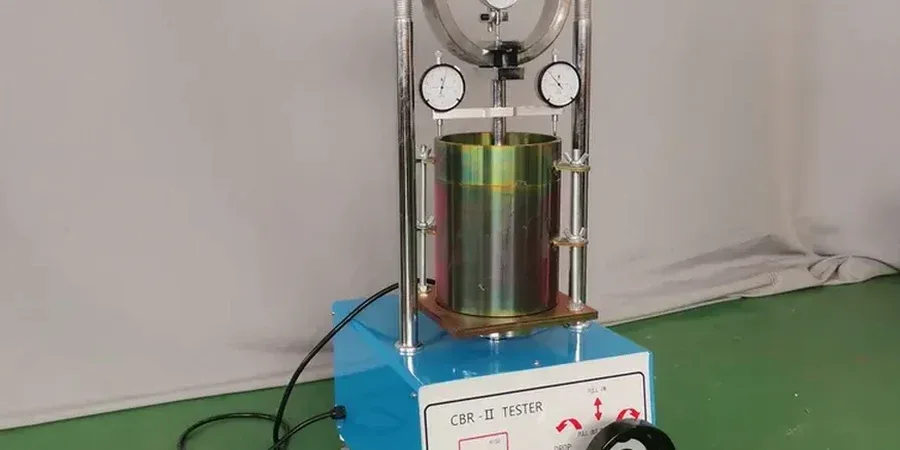
Birmingham sits at the tail end of the Appalachian foothills, where elevation swings from 460 feet downtown to over 1,100 feet atop Red Mountain. The terrain here is anything but uniform. Roadbeds and parking lots built on the city's weathered shale and silty clay residuals demand a clear picture of subgrade strength before the first truckload of asphalt arrives. Our laboratory CBR test provides that picture, measuring the California Bearing Ratio on remolded specimens compacted to target density. The results feed directly into AASHTO 93 pavement thickness design and local ALDOT specifications, giving engineers a defensible number for base and surface course layers. We run the procedure under ASTM D1883, with soaked and unsoaked conditions matched to the drainage reality of each site.

A soaked CBR below 3 percent on Birmingham's residual clay means the subgrade will pump fines under repeated loading — the pavement section needs a stabilization strategy, not just more stone.
Our approach and scope

The humidity that settles into Jones Valley from May through October reshapes how pavement subgrades behave over time. A CBR value measured at optimum moisture tells only part of the story. We routinely condition specimens for 96-hour soaking to simulate the worst-case saturated state that Birmingham's clay subgrades reach after a wet winter. The lab compacts material at modified Proctor energy and measures penetration resistance at 0.1-inch increments through 0.5 inches. Where the project involves deep cuts into the Conasauga shale formation, we pair the CBR data with slope stability analysis to confirm that the pavement section won't be undermined by bench instability. Swell potential is recorded alongside the load-penetration curve because volume change in the Red Mountain silt can be just as damaging as low bearing capacity.
Laboratory CBR Testing in Birmingham Alabama
Technical reference image — Birmingham Alabama

Local ground factors

The geological transition zone that runs through Birmingham creates a specific risk pattern for pavement projects. Residual soils derived from the Chickamauga limestone and the Rome Formation shale weather to a silty clay that loses significant strength when saturated. We have seen soaked CBR values drop from 8 percent to below 2 percent on the same material after 96 hours of immersion. This matters because ALDOT standard drawings assume a minimum design CBR of 3 percent for flexible pavement on local roads. A subgrade that falls below that threshold will rut within two years unless the section is thickened or chemically stabilized. The lab report includes the swell percentage explicitly because vertical heave in expansive shale beds underneath parking lots in the Highway 280 corridor has led to repeated pavement failures that could have been avoided with a proper CBR characterization before construction.

Need a geotechnical assessment?

Reply within 24h.

Email: contact@geotechnical-engineering.xyz

Service video

Typical values

ParameterTypical value
StandardASTM D1883-21
Compactive effortStandard or Modified Proctor (ASTM D1557)
Specimen conditioningUnsoaked, 96-hour soaked, or field moisture
Penetration rate0.05 in/min
Surcharge weight10 lb annular (simulates 6-inch base course)
Recorded swellDial gauge, 0.001-inch resolution, daily reading
Reported valuesCBR at 0.1 and 0.2 inches, % swell, moisture content

Related technical services

01

Soaked and Unsoaked CBR

Compacted specimens at target moisture and density, tested immediately or after 96-hour immersion. Both values reported with the load-penetration curve.

02

Swell Potential Measurement

Continuous dial-gauge recording during the soaking period. Critical for Birmingham's shale-derived subgrades where volume change drives cracking.

03

Proctor-CBR Correlation Package

Modified Proctor compaction curve plus CBR at three moisture contents. Identifies the sensitivity of bearing ratio to field placement moisture.

04

Stabilized Subgrade CBR

CBR testing on lime-treated or cement-treated soil specimens. Verifies strength gain after 7-day curing per ALDOT mix design requirements.

Reference standards

ASTM D1883-21 — Standard Test Method for California Bearing Ratio of Laboratory-Compacted Soils, ASTM D1557-12 — Standard Test Methods for Laboratory Compaction Characteristics of Soil Using Modified Effort, AASHTO T 193 — Standard Method of Test for The California Bearing Ratio, ALDOT Standard Specifications Section 301 — Soil-Lime and Soil-Cement Subgrade Treatment

Common questions

How much does a laboratory CBR test cost in Birmingham?
What soil types in Birmingham benefit most from CBR testing?

The residual silty clays and weathered shale that cover much of Jefferson County show dramatic strength loss when saturated. CBR testing is particularly valuable on these materials because visual classification alone does not predict how they will perform under traffic loading after a rainy season.

How long does it take to get CBR results from the lab?

An unsoaked CBR can be reported in 3 to 4 business days. Soaked tests with swell monitoring require the full 96-hour immersion period plus testing time, so expect results in 5 to 7 business days. We can accommodate rush requests when the paving schedule demands it.

Do I need a field CBR or a laboratory CBR for my pavement design?

Field CBR tests give a quick in-situ indication but do not control moisture or density. ALDOT pavement design is calibrated to laboratory CBR values on specimens compacted to a known compactive effort. For final design submittals, the lab test is the standard reference.

Location and service area

We serve projects across Birmingham Alabama and surrounding areas. More info.

View larger map