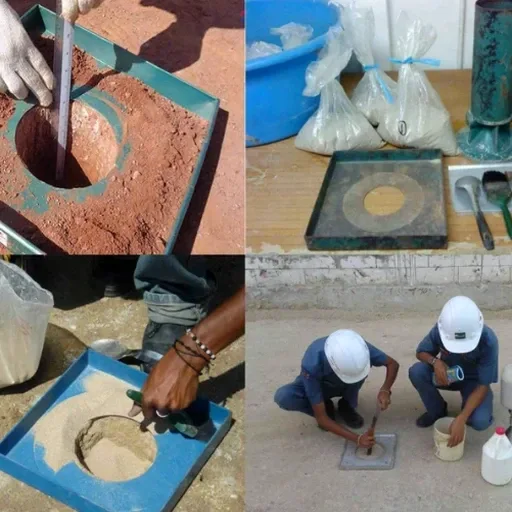
The sand cone device is deceptively simple: a calibrated glass jar, a metal cone valve, and a flat base plate resting directly on the compacted surface. In Birmingham, where residual silty clays and partially weathered shale dominate the shallow geology, the technician pours uniform Ottawa sand through the cone into the excavation, measuring the hole volume to compute in-place wet density. The method traces back to early Corps of Engineers work, but on our Ridge-and-Valley terrain it requires careful adjustment: thin chert seams at the surface can nick the plastic jug during transit between job sites along I-65. A standard kit weighs about 20 pounds loaded with sand, and in the humid Alabama summer the sand must be kept dry to avoid bridging inside the valve. When compaction curves are needed, the field data pairs directly with laboratory Proctor tests for standard or modified effort. For sites with deeper structural fill, we often run parallel SPT drilling to confirm that compaction extends through the full lift thickness.
Percent compaction above 95 percent of modified Proctor maximum is the hard cutoff for structural fill acceptance across Jefferson County, and the sand cone provides the legal record.
Common questions
How much does a sand cone field density test cost in Birmingham?
Is the sand cone method accepted by Birmingham building officials?
Yes. The City of Birmingham and Jefferson County both accept ASTM D1556 sand cone results for structural fill acceptance under IBC Chapter 18. The test provides a direct measurement of in-place density and is often preferred over nuclear methods when the fill contains slag, chert, or other materials that can skew indirect readings.
What causes a sand cone test to fail in Alabama soils?
The most common failure we see is soil loss from the hole walls collapsing before the sand can fill the cavity, which happens in dry sandy silts or granular fills with no cohesion. Another issue is moisture bridging in the sand when the relative humidity is high, causing the sand to clump inside the cone valve and produce an inaccurate volume reading.
How many tests do I need for a typical commercial building pad in Birmingham?
Jefferson County grading code generally requires one field density test per 1,500 square feet per compacted lift. For a 30,000-square-foot building pad with three lifts of fill, you would be looking at roughly 60 sand cone tests total. The geotechnical engineer of record can adjust the frequency based on material variability and project criticality.