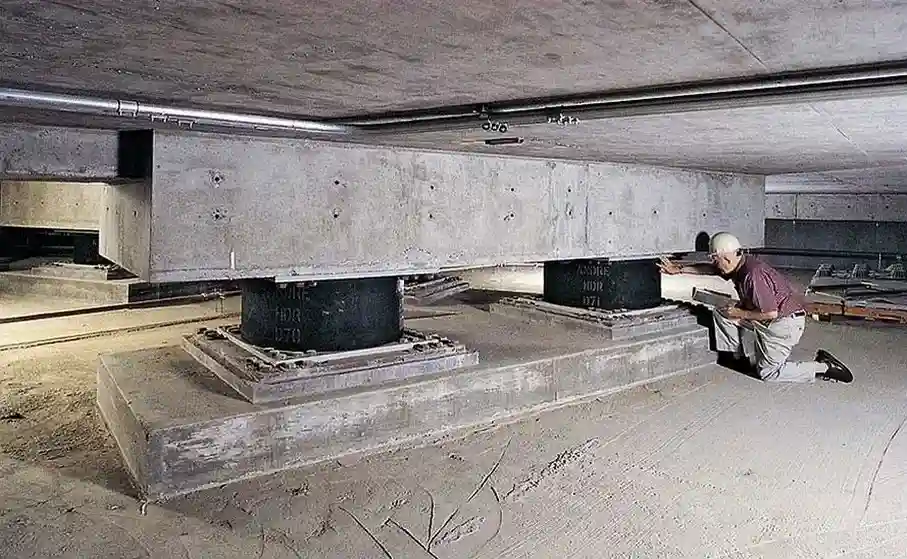
Birmingham's transformation from a post-Civil War iron furnace crossroads into Alabama's largest metropolitan area brought with it a legacy of industrial masonry buildings and modern steel-frame towers, both now facing distinct seismic demands. The city sits less than 200 miles from the Eastern Tennessee Seismic Zone, and while major events are infrequent, the 2003 Fort Payne earthquake—felt clearly in downtown Birmingham—served as a practical reminder that the region's moderate seismicity cannot be ignored in structural design. Our laboratory supports base isolation projects by characterizing the site-specific ground motions and soil profiles that govern isolator selection, ensuring that isolation systems are tuned to the actual subsurface conditions beneath Birmingham's variable geology rather than relying on generic code spectra. We combine in-situ seismic refraction surveys with laboratory dynamic testing to build the subsurface velocity models that feed directly into the isolator design process, an approach that becomes especially valuable where the transition from the Valley and Ridge province into the Coastal Plain creates abrupt stiffness contrasts within a single building footprint.
A base isolation system designed without site-specific soil dynamic properties is calibrated to a code spectrum that may differ from actual ground motion at the site by 30% or more in spectral acceleration.
Common questions
Does Birmingham require base isolation for new construction?
Birmingham follows the Alabama Building Code, which adopts the IBC with state amendments. Base isolation is not mandatory by occupancy class alone, but for Risk Category IV structures—hospitals, emergency response facilities, and designated shelters—the IBC permits isolation as an alternative to conventional seismic force-resisting systems when the design can demonstrate superior performance. The UAB medical district includes several structures where isolation was evaluated during design.
How long does site-specific ground motion characterization take for a Birmingham project?
A complete site-specific study typically requires four to six weeks from field investigation to final report. This includes one to two weeks for geophysical field work and soil sampling, two weeks for laboratory dynamic testing, and one to two weeks for analytical modeling and report preparation. Projects requiring coordination with a peer review panel may extend the timeline by an additional two weeks.
What is the typical cost range for base isolation testing and site characterization in Birmingham?
How does the Red Mountain geology affect base isolation design?
Red Mountain is underlain by the Silurian Red Mountain Formation—interbedded sandstone, shale, and iron-rich layers that dip southeast. This dipping stratigraphy creates a site condition where the depth to competent rock can vary by 30 feet or more across a single building pad. The resulting lateral stiffness contrast affects how ground motion propagates to the isolation plane, and our site-specific analyses capture this variability so that the isolation system is designed for the most demanding condition across the footprint rather than for an averaged profile.