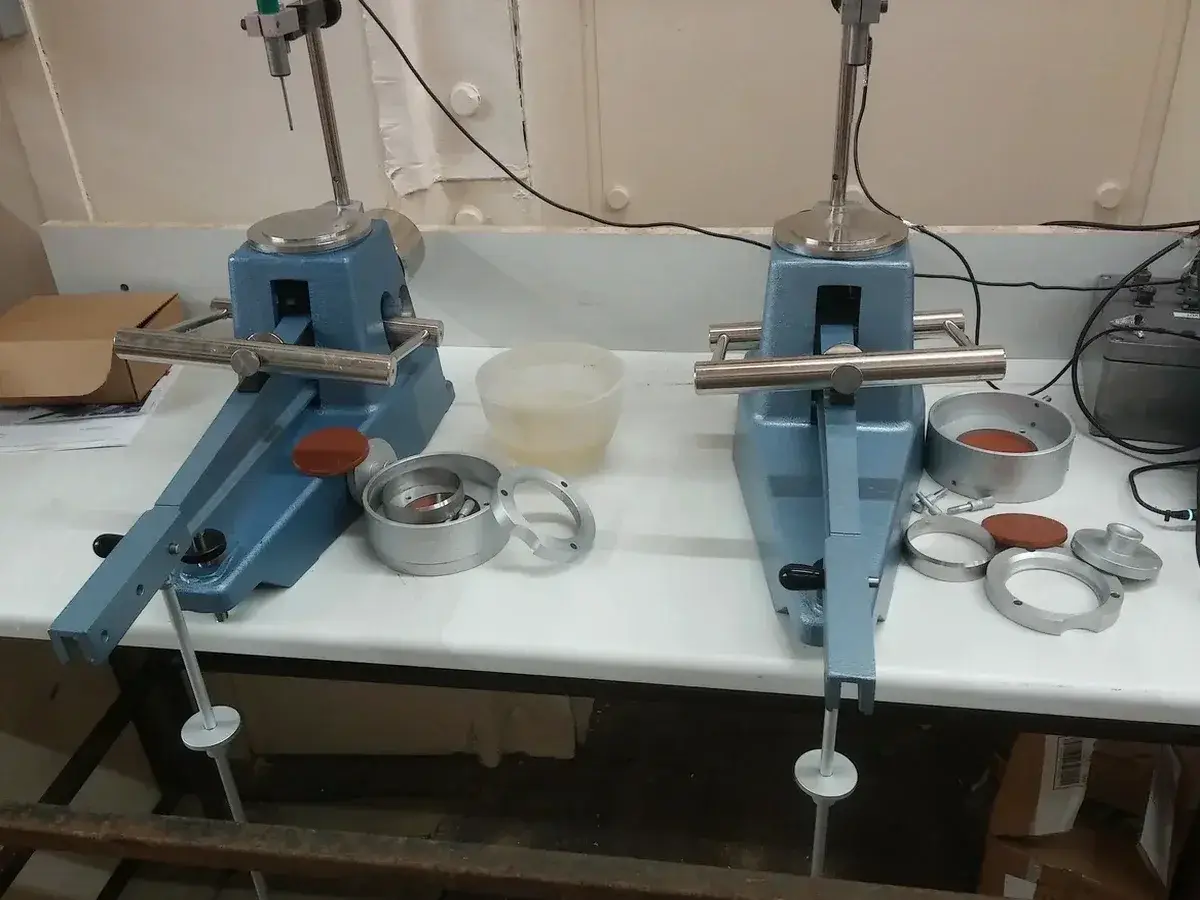
A recent 5-story mixed-use project on the Southside hit a nasty surprise during excavation: the red clay that looked solid in the auger cuttings turned to sticky putty after three days of rain. Water pooled in the footing trenches and the contractor lost a week while the geotech engineer scrambled to confirm the soil’s plastic limit. That week cost real money. Birmingham sits on the Southern Piedmont — a landscape of weathered schist and gneiss that produces silty clays with high plasticity indices. The difference between a site that handles moisture and one that heaves or collapses often comes down to a single number: the Atterberg limits. Our lab runs these tests under ASTM D4318 protocols, giving your structural team the liquid limit, plastic limit, and plasticity index they need before the concrete goes in. When we suspect fat clays at depth, we pair the Atterberg analysis with a grain size distribution test to classify the material under the Unified System, especially in transition zones where the weathered rock grades into saprolite.
A plasticity index above 30 in Birmingham's Piedmont clays signals volume change potential that no amount of site drainage can fully mitigate — the foundation design has to account for it directly.
Local ground factors
Birmingham averages 54 inches of rain a year, and the humidity rarely drops below 60 percent. That persistent moisture feeds directly into the shrink-swell cycle of the local clay. The 2018 NOAA climate normals update confirmed a trend toward more intense rainfall events in Jefferson County — the kind that saturate the active zone below footings in less than 24 hours. A soil with a liquid limit of 55 and a plastic limit of 20 — a PI of 35 — can exert swelling pressures exceeding 5,000 psf under a slab-on-grade if the moisture content swings from dry to saturated. Those pressures are enough to lift a lightly loaded structure unevenly, causing drywall cracks, sticking doors, and broken utility lines. Skipping the Atterberg limits on a site with Piedmont residual clay is a gamble that the Birmingham building department won't let you take anyway; the IBC 2021 references expansive soil classification directly, and the local plan reviewer will ask for the PI number before approving the foundation drawings.
Reference standards
ASTM D4318-17e1: Standard Test Methods for Liquid Limit, Plastic Limit, and Plasticity Index of Soils, ASTM D2487-17: Standard Practice for Classification of Soils for Engineering Purposes (Unified Soil Classification System), IBC 2021 Section 1803: Geotechnical Investigations — Expansive Soil Requirements, AASHTO T 89-13: Determining the Liquid Limit of Soils, AASHTO T 90-16: Determining the Plastic Limit and Plasticity Index of Soils