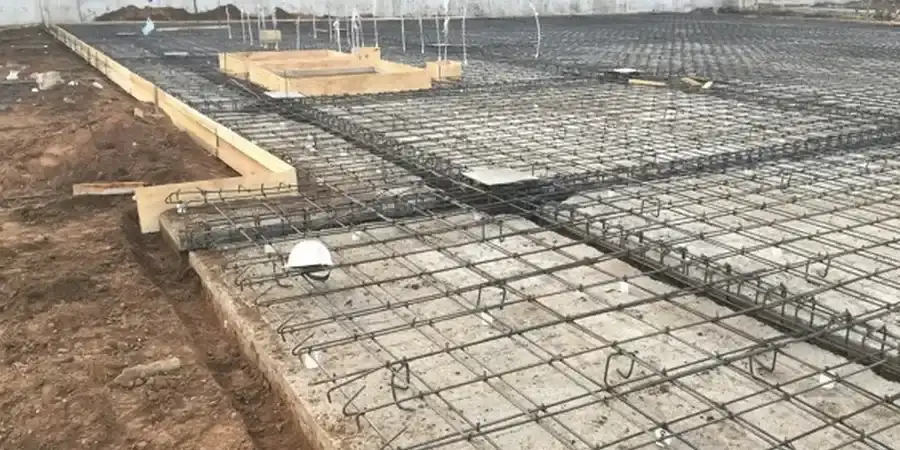
In Birmingham, we encounter a lot of projects where conventional footings just don’t cut it. The Valley and Ridge geology underlying Jefferson County gives us interbedded shale, limestone, and the notorious Conasauga Formation clays that swell with seasonal moisture. When a site has marginal bearing capacity or variable strata, a raft/mat foundation design becomes the practical solution to distribute structural loads and minimize differential settlement. Our team has worked across the entire metro — from downtown high-rises to industrial pads near the Black Warrior River — combining local drilling data with advanced finite element modeling. Before locking in slab thickness, we typically run a CPT test to map continuous stratigraphy, which feeds directly into the modulus of subgrade reaction used in the mat analysis.
A raft foundation on Birmingham’s Conasauga shale demands more than a uniform pressure assumption — it needs a subgrade model calibrated to real site data.
Local ground factors
On a recent warehouse project near Pinson Valley, the owner considered skipping the mat foundation to save upfront cost. The geotech report showed 12 feet of fat clay over weathered shale. By year two, a neighboring building on isolated footings had already developed 1.5 inches of differential settlement, cracking CMU walls and jamming overhead doors. Our client’s raft foundation, designed with a perimeter beam and void forms over the expansive zone, remained level with zero slab curling. The lesson here is simple: Birmingham’s subgrade doesn’t forgive shortcuts. A mat foundation isn’t an expense — it’s insurance against the repair bills that come from ignoring what lies beneath the topsoil.
Common questions
When is a raft/mat foundation better than isolated footings in Birmingham?
A mat foundation becomes the better choice when the soil bearing capacity is below 2,000 psf, when isolated footings would cover more than 50% of the building footprint, or when the site is underlain by expansive clays typical of the Conasauga Formation. It also provides superior resistance to differential settlement in areas with pinnacled limestone bedrock, which is common across Jefferson County.
What does a raft/mat foundation design cost in Birmingham?
How do you account for Birmingham's shrink-swell clays in the design?
We address expansive clays by specifying a minimum mat stiffness that resists edge heave, incorporating void forms or a granular capillary break beneath the slab, and detailing reinforcement to control crack widths. The design is calibrated to the soil’s plasticity index and swell potential, which we obtain from the geotechnical investigation per ASTM D4318.
Is a mat foundation suitable for Birmingham's seismic conditions?
Yes. Birmingham lies within the Southern Appalachian Seismic Zone, where site class D soils are common. A properly designed mat foundation acts as a rigid diaphragm, distributing lateral forces evenly to the ground. We apply ASCE 7-22 seismic coefficients specific to the site’s latitude and longitude, ensuring the slab has adequate strength and ductility for the design earthquake.
What site investigation data is required before designing a mat foundation?
At minimum, we need SPT borings (ASTM D1586) or CPT soundings (ASTM D5778) extending to a depth of at least twice the mat width, laboratory classification of soil samples, and groundwater level measurements. For sites near the Black Warrior River or its tributaries, we also recommend a seasonal high groundwater assessment to properly design underslab drainage and buoyancy checks.