← Home · Foundations

Shallow Foundation Design in Birmingham, AL: Bearing Capacity & Settlement on Piedmont Soils

Together, we solve the challenges of tomorrow.

LEARN MORE →

Birmingham sits at the tail end of the Appalachian foothills, where the geology shifts from hard sedimentary rock to deep residual soils. Much of the city overlies the Conasauga Formation, producing stiff silty clays and sandy silts typical of the Piedmont physiographic province. These soils are not simple elastic materials. They carry a complex stress history from millions of years of weathering, and their behavior under load varies significantly within a single site. For shallow foundation design in Jefferson County, the critical step is distinguishing between intact residuum and zones where carbonate rock has dissolved beneath the surface. A footing that looks stable on paper can fail if it bridges a clay-filled fissure. Our team has worked on projects from the Red Mountain slopes to downtown infill sites near Railroad Park, and the first rule here is always the same: never extrapolate subsurface conditions from a single boring. We frequently pair our bearing capacity evaluations with in-situ permeability testing to assess drainage around foundation elements, especially where the weathered rock profile varies sharply across the site.

Piedmont residual soils in Birmingham retain fabric from the parent rock; treating them as simple clays underestimates their stiffness and overestimates their long-term settlement potential.

Our approach and scope

A medical office building on Montclair Road illustrated the local challenge perfectly. The geophysical survey suggested uniform residual clay, but test pits at footing depth exposed a weathered limestone pinnacle dipping 30 degrees across the pad footprint. Differential settlement was the real risk, not shear failure. We designed a spread footing system with a structural slab bridging the transition zone; the bearing pressure was kept at 2,500 psf to stay well below the residual soil's undrained shear strength, which field vane tests confirmed at over 2.0 ksf across most of the site. Shallow foundations in Birmingham succeed when the design acknowledges that Piedmont residuum is not a homogeneous stratum. It is a transitional material with relict jointing, variable cementation, and occasional soft seams of decomposed feldspar. Standard penetration testing remains our go-to for screening, but in this formation the SPT blow count alone can be misleading without mineralogical context. Where the residuum thins over pinnacled rock, we often recommend a CPT test to obtain a continuous strength profile that identifies hard inclusions before they become surprises during excavation.
Shallow Foundation Design in Birmingham, AL: Bearing Capacity & Settlement on Piedmont Soils
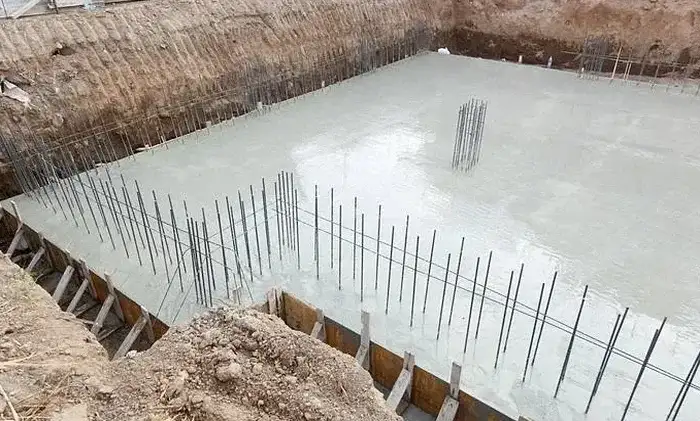
Technical reference image — Birmingham Alabama

Local ground factors

Birmingham recorded 627 feet of elevation change across its city limits, from the valley floor along Village Creek up to the crest of Red Mountain. That topographic relief drives the two most persistent risks for shallow foundations here: colluvial creep on slopes and sinkhole development in the valley. The Conasauga limestone underlying much of the central business district is a documented karst aquifer, and the Alabama Department of Environmental Management maintains a sinkhole database that shows concentrated subsidence activity along the I-65 corridor. A footing placed over a soil-filled cavity may show no warning signs during construction and then settle abruptly after a heavy rain season when the clay bridge softens. The second risk is expansive clay behavior in the weathered shale zones of the Chickamauga Limestone formation. These clays can swell 3 to 5 percent under moisture change, generating uplift pressures that exceed the dead load of a lightly loaded slab-on-grade. Our design approach for at-risk parcels always includes a site-specific swell test (ASTM D4546) and a graded filter layer that breaks capillary rise before it reaches the footing bearing surface.

Need a geotechnical assessment?

Reply within 24h.

Email: contact@geotechnical-engineering.xyz

Typical values

ParameterTypical value
Typical net allowable bearing pressure (residual CL)1,800 – 2,500 psf
Design groundwater depth (Valley & Ridge)8 – 25 ft bgs, seasonal variation ±6 ft
Minimum footing embedment (frost depth)12 in per IBC, 18 in recommended for expansive zones
Undrained shear strength range (residuum)1,200 – 2,800 psf from field vane
Seismic site class (typical residuum profile)C to D per ASCE 7-22, based on Vs30
Settlement tolerance for spread footings1 inch total, 0.75 inch differential per IBC Table 1604.5
Karst feature setback (per ADEM guidance)Minimum 25 ft from identified sinkhole rim

Related technical services

01

Spread Footing & Mat Foundation Design

We design isolated, combined, and mat foundations for commercial and industrial structures on Piedmont residual soils. The analysis incorporates Terzaghi-Meyerhof bearing capacity equations with strength parameters from consolidated-undrained triaxial tests, and consolidation settlement is computed using Casagrande's graphical method on incremental oedometer data. For mats on variable residuum, we run a Winkler spring model with subgrade reaction modulus calibrated to the site's shear wave velocity profile.

02

Settlement Monitoring & Construction Phase Verification

Before concrete is placed, our field team verifies bearing stratum consistency at every footing excavation using a dynamic cone penetrometer and visual classification per ASTM D2488. We install settlement plates and survey monuments for structures with design loads exceeding 200 kips per column, taking readings at foundation pour, framing completion, and at 3-, 6-, and 12-month intervals post-occupancy. This monitoring data confirms that observed settlement tracks within the predicted envelope and triggers corrective action if differential movement exceeds 0.5 inch between adjacent columns.

Reference standards

IBC 2021 Chapter 18 – Soils and Foundations, ASCE 7-22 – Minimum Design Loads for Buildings, ASTM D1586-18 – Standard Penetration Test (SPT), ASTM D4546-21 – One-Dimensional Swell or Collapse of Soils, ACI 318-19 Chapter 13 – Foundation design provisions, ADEM Division 335-6 – Karst terrain construction guidance

Common questions

What is the typical cost range for a shallow foundation geotechnical investigation in Birmingham?
How deep do footings need to be in Birmingham to avoid frost heave?

The IBC prescribes a minimum 12-inch embedment for frost protection in this climate zone, but in Birmingham's expansive clay zones we routinely specify 18 inches of embedment with a capillary break layer of clean crushed stone. The deeper embedment moves the bearing surface below the active moisture fluctuation zone, which is where most heave originates in the weathered Chickamauga shale soils found across the southern part of the city.

Can you design shallow foundations on fill soils in Birmingham?

Yes, but only when the fill is engineered and documented. Uncontrolled fill is common in older parts of Birmingham, especially in the Avondale and East Lake neighborhoods where residential lots were regraded decades ago without compaction records. For engineered fill, we require a Proctor-based compaction specification with density testing every 12 inches of lift thickness. For undocumented fill, we either remove it entirely below footing influence depth or recommend deepening the foundation to competent residuum, which in some Birmingham valleys can be 15 feet or more below the surface.

How do you account for sinkhole risk when designing a spread footing?

We incorporate the Alabama Department of Environmental Management's sinkhole proximity guidelines and supplement the geotechnical boring program with electrical resistivity imaging when the site lies within a mapped karst zone. The resistivity profile identifies air-filled or clay-filled cavities larger than about 3 feet in diameter. If a cavity is detected within the footing influence zone, we either relocate the footing, design a reinforced concrete mat that can span a potential void with minimal deflection, or specify low-mobility grouting to stabilize the cavity before foundation construction begins.
Location and service area

We serve projects across Birmingham Alabama and surrounding areas.

View larger map